

A weekly grocery budget is easy to set and hard to keep. The number looks fine on Sunday, and by Thursday it has been blown by a “quick trip” for milk that came home with $40 of extras.
It’s worth getting right, because the checkout total keeps creeping up and food is one of the few big bills you can change from one week to the next.
This guide covers both halves: how to pick a weekly number that’s realistic, and the habits that keep you under it.
Jump to a section
Why Weekly Works Better Than Monthly
A month is a long time to keep track of. Overspend in week one and you won’t feel it until week four. A weekly number gives you a fresh start every seven days, and it matches how most families already shop.
Step 1: Find Your Starting Number
Pull the last four weeks of receipts or card statements. Add up everything spent at grocery stores, warehouse clubs and corner-store top-ups, then divide by four. That’s your real weekly average, and it’s often higher than people guess.
If you can, separate food from non-food items like paper goods, toiletries and pet food. They share a receipt, but they’re easier to control as separate lines.
Step 2: Set a Target You Can Keep
Compare your average with a benchmark. USDA publishes food budgets every month at four spending levels, and we break them down in How Much Should a Family of 4 Spend on Groceries?.
Then trim modestly. Aim for about 10 percent less than you spend now, so a $250 week becomes $225. Hold that for a month, and trim again if it felt easy. A target you hit beats an ambitious one you abandon.
Step 3: Plan the Week Before You Shop
- Check the kitchen first. Look through the fridge, freezer and pantry, and plan the first dinners around what needs using up.
- Plan five dinners, not seven. Leave one night for leftovers and one for a pantry meal like black bean quesadillas or veggie fried rice.
- Reuse ingredients. Nothing should be bought for a single recipe. Our week of healthy dinners from 10 ingredients is built this way.
- Let the sales decide. Check the store flyer or app and build two or three dinners around the proteins on sale.
- Write the list with prices. Put a rough price next to each item and total it before you leave the house.
Step 4: Stick to It in the Store
- Keep a running total. Use the calculator on your phone, or round each item up to the next dollar and add as you go.
- Shop once. Every extra trip is a chance to pick up extras.
- Compare unit prices. The shelf tag shows the price per ounce or per pound. That’s the number that tells you which package is cheaper.
- Try the store brand first. Staples such as canned tomatoes, beans, pasta, flour, butter and frozen vegetables are good places to start.
- Choose the treat ahead of time. Put one on the list. A planned treat costs less than three unplanned ones.
- Eat before you go. Shopping hungry fills the cart with snacks.
- Consider pickup. If your store offers it without a fee, ordering online lets you watch the total as you add items and remove things before you pay.
- Use cash or a separate card. Put the week’s grocery money in an envelope or on its own debit card. When it’s gone, it’s gone.
Step 5: Build In a Buffer
Some weeks you’ll find chicken thighs or butter at a price worth stocking up on. Set aside a small part of the budget, around $10 to $15 a week, as a stock-up fund that rolls over when you don’t use it. That way a good sale doesn’t wreck the week.
What you stock up on has to get eaten, so freeze it with a plan. Our best freezer meals to make ahead can help.
A Sample Weekly Budget
Here’s one way a $225 week could be divided. It’s an example to adapt, not a rule.
| Category | Amount |
|---|---|
| Five planned dinners | $90 |
| Breakfasts and lunches | $60 |
| Fruit, vegetables and snacks | $35 |
| Staples and refills (oil, flour, spices, coffee) | $25 |
| Stock-up buffer | $15 |
| Total | $225 |
What to Do When You Go Over
It will happen. A birthday, a holiday, a week when everyone is sick.
- Go back to the number. Don’t try to pay it back by starving next week’s budget.
- Look for the cause. Extra trips, takeout on top of groceries and unplanned snacks are the usual ones.
- Run a pantry week. Plan the next week’s dinners mostly from the freezer and cupboard. These 15 pantry staples make that easier.
- Check the target. If you’re over three weeks out of four, the number is wrong, not you. Raise it a little and try again.
Free Printables
Two free printables go with this guide. The worksheet covers steps 1 and 2 and tracks four weeks of spending. The planner covers step 3: the week’s dinners and a grocery list with prices.
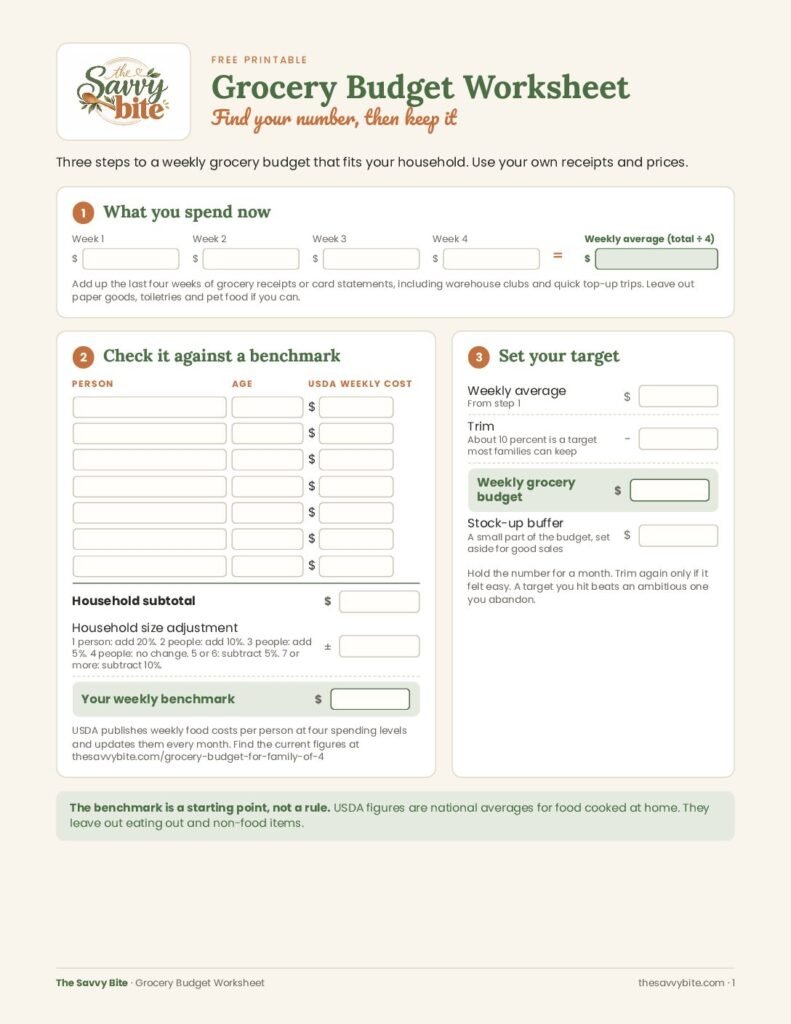
Grocery Budget Worksheet
Two pages: three steps to set your weekly number, plus a four-week spending tracker. Free, with no sign-up needed.

Weekly Meal Planner and Grocery List
Two pages: a dinner plan for the week and a grocery list sorted by store section, with room for prices. Free, with no sign-up needed.
See all of our free printables.
Grocery Budget Questions
Should the grocery budget include household items?
Either way works, as long as you’re consistent. Tracking food separately makes it easier to compare your spending with food-only benchmarks like USDA’s.
What if two people do the shopping?
Share one list and one running total. A shared note on your phones is enough, as long as both people add what they spend.
What if I’m paid once a month?
Divide the month’s grocery money by the number of shopping weeks in that month, then treat each week’s share separately. It stops the money running short in the last week.
The Short Version
Find out what you spend now, set a target slightly below it, plan the week before you shop and keep a running total in the store. None of it is complicated. It just has to happen every week.
This post shares general budgeting information, not personal financial advice.
More money-saving reads: How Much Should a Family of 4 Spend on Groceries? and How to Reduce Food Waste at Home.