

This post contains affiliate links. As an Amazon Associate, we earn from qualifying purchases.
Ask ten families what they spend on groceries and you’ll get ten different answers. That makes it hard to know whether your own grocery budget for a family of 4 is reasonable or quietly out of control.
It matters more than ever. When a full cart costs what it does now, a clear number to aim for is one of the most useful things a household can have.
You don’t have to guess. The U.S. Department of Agriculture publishes food budgets every month at four spending levels. Here’s what they say a family of four spends, and how to turn that into a number that fits your house.
Jump to a section
The Short Answer
Using USDA’s August 2026 figures, a family of four that cooks all of its meals at home spends roughly $236 to $387 a week on food, or about $1,024 to $1,679 a month. Where you land in that range depends on how you shop and what you buy.
| USDA food plan | Per week | Per month |
|---|---|---|
| Thrifty | about $236 | about $1,024 |
| Low-Cost | about $260 | about $1,126 |
| Moderate-Cost | about $321 | about $1,388 |
| Liberal | about $387 | about $1,679 |
Source: USDA Official Food Plans, Cost of Food reports, U.S. average for August 2026. The family is two adults (about 20 to 50 years old) and two children, one aged 6 to 8 and one aged 9 to 11. The Thrifty row is USDA’s own figure for that family. The other three rows are our sums of USDA’s per-person costs, rounded to the nearest dollar.
What the Four USDA Plans Mean
All four plans describe a nutritious diet. The difference is how much room there is in the cart. USDA doesn’t hand out a shopping list for each one, but in practice the gap looks something like this:
- Thrifty: the leanest plan, and the one SNAP benefits are based on. Expect lots of cooking from scratch with staples like rice, beans, eggs, chicken and in-season or frozen produce.
- Low-Cost: still careful, with a little more room for meat, fresh produce and the occasional shortcut.
- Moderate-Cost: more variety and more convenience foods.
- Liberal: the most flexible plan, with pricier cuts of meat, more specialty items and less attention to sales.
Most families watching their budget will aim for the Thrifty or Low-Cost number.
Three Things These Numbers Leave Out
- Eating out. USDA assumes every meal and snack is prepared at home. Takeout, restaurant meals and cafeteria lunches are extra.
- Non-food items. The plans cover food only. Paper towels, diapers, pet food, toiletries and cleaning supplies aren’t included, even though they often land on the same receipt.
- Where you live. These are national averages. Prices run higher in some places and lower in others, so treat the figures as a starting point, not a rule.
What Does the Average Family of 4 Spend on Groceries?
USDA’s food plans aren’t a survey of what families actually spend. They show what a healthy diet costs at four budget levels. That makes them a better guide than an average, which mixes families that eat out every night with families that cook everything at home.
If you want a middle-of-the-road number, the Moderate-Cost plan sits in the middle of the four: about $321 a week, or about $1,388 a month, for a family of four cooking at home. Most families trying to save will aim lower, at the Thrifty or Low-Cost level of about $236 to $260 a week.
It’s possible to spend much less than the USDA plans for a while if you plan carefully. Our $100 a week meal plan and $50 a week plan for a family of 4 show what that looks like, with every meal priced. They lean hard on beans, rice, eggs and pasta and leave little room for snacks or extras, so treat them as short-term plans for tight months rather than a long-term target.
How to Adjust for Your Own Family
The table above fits one specific family. USDA also publishes weekly costs per person, which makes it easy to build your own number. These are the August 2026 figures for the two plans most budget-minded families use:
| Person | Low-Cost, per week | Moderate-Cost, per week |
|---|---|---|
| Child, 2 to 3 years | $40.10 | $47.80 |
| Child, 4 to 5 years | $41.30 | $51.10 |
| Child, 6 to 8 years | $60.50 | $70.30 |
| Child, 9 to 11 years | $62.50 | $80.70 |
| Girl, 14 to 18 years | $62.40 | $74.60 |
| Boy, 14 to 18 years | $74.40 | $93.10 |
| Woman, 19 to 50 years | $63.60 | $77.60 |
| Man, 19 to 50 years | $73.20 | $91.90 |
| Woman, 51 to 70 years | $62.00 | $76.40 |
| Man, 51 to 70 years | $69.00 | $86.50 |
Add up the people in your house, then apply USDA’s adjustment for household size. Larger households can buy and cook in bigger quantities, so the cost per person drops:
- 1 person: add 20 percent
- 2 people: add 10 percent
- 3 people: add 5 percent
- 4 people: no change
- 5 or 6 people: subtract 5 percent
- 7 or more people: subtract 10 percent
Example: two parents with a teenage son and a teenage daughter come to about $274 a week on the Low-Cost plan ($73.20 + $63.60 + $74.40 + $62.40). That’s about $14 a week more than the same plan for a family with two younger children. Teenagers eat more, and the budget should admit it.
How to Pick Your Number
- Find what you spend now. Add up the last four weeks of grocery receipts or card statements, food only if you can, and divide by four.
- Compare it with the table. If you’re near Thrifty or Low-Cost, you’re already running lean. If you’re above Liberal, there is probably easy money to save.
- Aim one step down, not three. Trimming $20 to $30 a week is something a family can keep up. Slashing the bill in half usually ends in takeout.
- Give it a month, then adjust. One expensive week doesn’t mean the number is wrong. Four in a row does.
Once you have a target, our guide to setting a weekly grocery budget and sticking to it covers the week-by-week part.
Ways to Move Down a Plan Without Eating Worse
- Plan dinners before you shop. A plan that reuses ingredients, like a week of healthy dinners from 10 ingredients, keeps the list short.
- Build meals on cheap staples. Start with these 15 pantry staples every budget cook should have.
- Stretch the meat. Here are 10 ways to stretch ground beef into multiple meals.
- Cook once, eat twice. Double a recipe and freeze half in freezer-safe containers. Our best freezer meals to make ahead are a good place to start.
- Waste less. USDA says the average American family of four loses $1,500 a year to uneaten food. See 12 ways to reduce food waste at home.
- Keep a list of low-cost dinners. Try these budget dinners for a family of 4.
Free Printable: Grocery Budget Worksheet
Ready to find your own number? This free worksheet has a table for adding up your household at USDA’s per-person costs, the household-size adjustment and a four-week spending tracker.
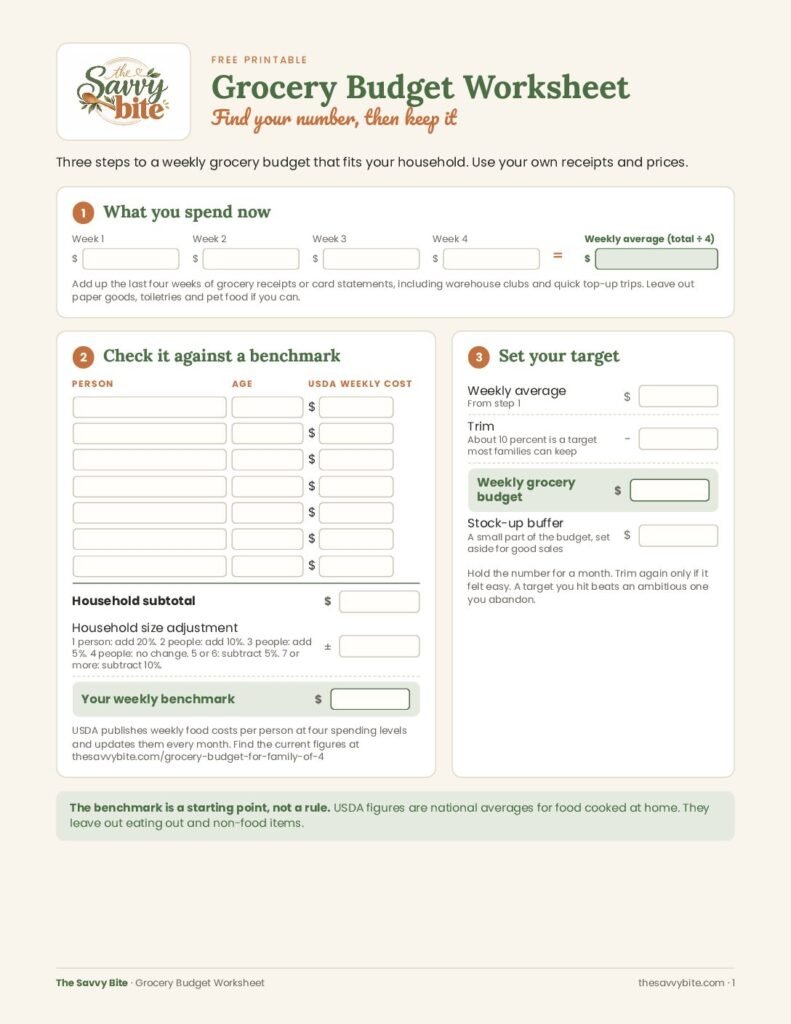
Grocery Budget Worksheet
Two pages: three steps to set your weekly number, plus a four-week spending tracker. Free, with no sign-up needed.
See all of our free printables.
Grocery Spending Questions
Is $200 a week enough for a family of four?
It’s below USDA’s Thrifty figure of about $236, so it’s lean. It takes cooking nearly everything from scratch, leaning on beans, eggs, rice, pasta and chicken thighs, and wasting very little. If $200 is your number, plan every dinner before you shop.
How much is that per person per day?
For the family in the table, the Thrifty plan works out to about $8.44 per person per day and the Moderate-Cost plan to about $11.45, covering three meals and snacks.
Does a grocery budget include eating out?
USDA’s numbers don’t. If your family eats out, either lower the grocery number to match the meals you won’t be cooking or keep a separate line for restaurants and takeout.
How often do these numbers change?
USDA updates the costs every month to keep up with food prices. The figures here are for August 2026, so check the latest report if you’re reading this much later.
How much should a family of 4 spend on groceries per month?
Using USDA’s August 2026 figures, about $1,024 a month on the Thrifty plan, $1,126 on the Low-Cost plan, $1,388 on the Moderate-Cost plan and $1,679 on the Liberal plan. Most budget-minded families aim for $1,024 to $1,126.
How much money do 4 people need for food a week?
About $236 to $387 a week if they cook all their meals at home, depending on the plan. A lean, carefully planned week can cost much less, but it takes cooking almost everything from scratch.
Where to Start
A family of four that cooks at home should plan on somewhere between about $236 and $387 a week for food, and most families watching their spending will aim for $236 to $260. Use the number as a guide, not a grade. Your own spending, your family’s ages and your local prices matter more than any national average.
This post shares general budgeting information, not personal financial advice.
More money-saving reads: How to Set a Weekly Grocery Budget and How to Reduce Food Waste at Home.